
Your blog post
Blog post description.
1/12/20262 min read
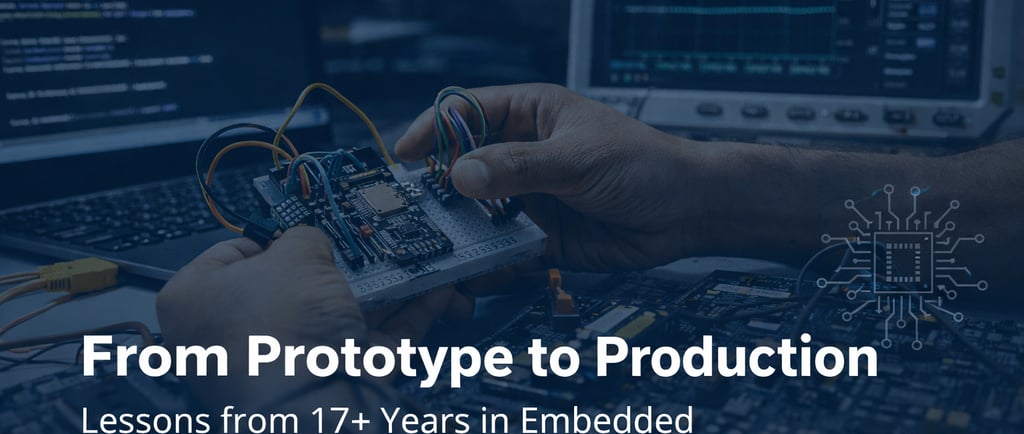
From Prototype to Production: Lessons from 17+ Years in Embedded Systems Engineering
When people talk about embedded systems, the discussion often starts with microcontrollers, sensors, or code snippets. In real-world engineering, however, embedded systems are much more than that. They are about reliability, determinism, maintainability, and long-term performance under real operating conditions.
Having spent more than 17 years working across industrial automation, medical devices, mobility systems, IoT platforms, and machine-vision solutions, I have learned that the biggest challenges in embedded engineering rarely come from writing code—they come from design decisions made too early or too casually.
Engineering Beyond the Prototype
Many embedded projects start as prototypes, often built quickly to demonstrate feasibility. While this approach is useful, problems arise when prototype-level decisions are carried into production without rethinking architecture, memory usage, task design, and failure handling.
In my experience, production-ready embedded systems require:
Deterministic task behavior (especially in RTOS-based designs)
Clear separation between drivers, middleware, and application logic
Robust communication handling with retries, timeouts, and diagnostics
Thoughtful memory and resource management
Hardware–software co-design, not isolated development
These principles apply whether you are building a small IoT device or a large industrial control platform.
Real-Time Systems Demand Discipline
Working with RTOS environments such as FreeRTOS and ThreadX across multiple projects taught me that real-time systems reward discipline and punish shortcuts. Task priorities, stack sizing, inter-task communication, and timing analysis must be deliberate—not experimental.
One common mistake I encounter is tightly coupling application logic with communication drivers. While it may work initially, it becomes difficult to debug, extend, or scale. Moving retry mechanisms, error handling, and state management to the application layer often results in cleaner designs and better long-term maintainability.
Embedded Linux Is a System, Not Just an OS
Embedded Linux projects bring a different class of challenges. Kernel configuration, BSP customization, device-tree design, and user-space integration must align with the hardware and the product’s operational goals.
Over the years, I have worked on systems involving Yocto-based builds, embedded Linux bring-up, and device integration, where success depended less on “getting Linux to boot” and more on:
Boot-time optimization
Driver stability
Field upgradability
Clear separation between platform and application layers
A stable embedded Linux system is not accidental—it is engineered.
Learning from Industrial and Medical Systems
Working on industrial automation and medical systems, including ventilators, gas flow analyzers, elevator monitoring platforms, and power management systems, reinforced one critical lesson:
failure scenarios must be designed, not discovered in the field.
Error handling, redundancy, logging, and safe fallback modes are not optional in such systems. They are core features.
Why Pyxis Exists
Pyxis was created to bring this production-focused mindset to every project—whether it is a startup building its first product or an OEM optimizing an existing platform. The goal is simple:
build embedded systems that work reliably, scale gracefully, and remain maintainable over time.
If you are building an embedded product and want to move confidently from prototype to production, thoughtful engineering from day one makes all the difference.
What’s Next
In future posts, I will share insights on:
RTOS architecture best practices
Embedded Linux bring-up lessons
IoT reliability and communication design
Debugging strategies for complex embedded systems
If you would like to discuss an embedded challenge or product idea, feel free to reach out through the Contact page.
If you want, I can:
Shorten this for SEO
Add diagrams/topics for follow-up blogs
Create a series plan (10–12 blog topics tailored to your services)
Rewrite it in a more marketing-oriented tone or more technical tone